A test town, a control town: knowing whether a campaign worked
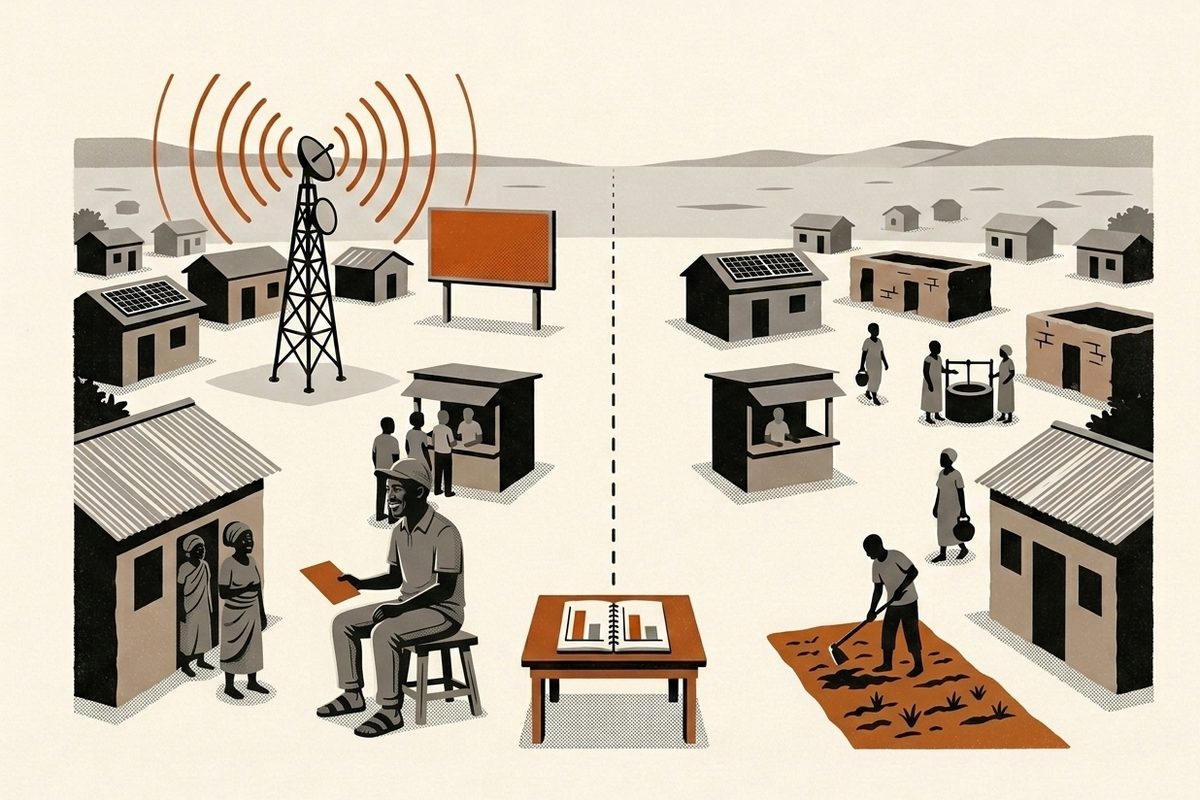
The most accurate question a leader ever asked me about a campaign fitted in one sentence. We launch a big campaign in a market, growth speeds up a little: how do we know whether it is the campaign, the season or word of mouth?
Without a point of comparison, nobody knows. The next budget is then decided on the best-told story.
Two towns that look alike
My answer is a simple set-up. I pick two towns of the same size, the same language, similar habits. The campaign runs in one. The other gets nothing. Over the same period, I compare the same indicators in both.
If the test town grows and the control town does not, the campaign did something. If both grow as much, it was the season. It is not a laboratory trial, but it is the difference between a conviction and a measurement.
One detail decides everything: the control town has to stay out of the campaign's reach. A radio station that covers both towns makes the comparison useless. So I choose the towns from media coverage, not only from the map.
Writing the threshold before starting
Before launch, I write down the expected result on three levels: cautious, base, high. And the result below which I stop.
Written afterwards, a threshold always adjusts to the result obtained. Written before, it protects the team from itself, and me with it.
A code per channel
Comparing two towns says whether the campaign worked. It does not say which channel did the work: the radio, the poster, the agent in the street.
To know that, every new customer has to carry where they came from. In the solar energy group where I led marketing, I had a simple field added to the agents' app: how did the customer hear about us? Not every agent filled it in. Enough did to stop paying for channels that brought nobody.
Repeating before extending
One town that succeeds is not enough. The same campaign has to succeed in a second town, then in a second country, before scaling to national or regional level.
On the same digital set-up, I have seen a gap of one to fifty between two countries. What worked once is only a clue.
What it costs
The method has a price. The control town does not get the campaign, so it sells less during the test. The test takes weeks when management wants an answer now. And in a very small market, there are sometimes no two comparable towns.
I accept it, because the alternative costs more: extending to a whole country a campaign nobody knows worked.
What I keep from it
A campaign is not judged on what it produced. It is judged on what it produced beyond what would have happened without it.
Further reading: market access in emerging markets, and when the calendar invents the bad news.
Was your last campaign compared with what would have happened without it? Request a growth audit
Before I decide for several countries, I go and look at one
Listen in one country, build with its team, bring it back to the group. And the three guardrails that stop an anecdote becoming a strategy.
ReadThe TV night: a field idea that outlived the television
Televisions that would not sell, an evening at a neighbour's, 16% of guests turned customers. Then the idea sold phones.
ReadBefore I fund a campaign, I listen to two hundred customers
More than two hundred customers asked in their own language. Over 60% came through word of mouth, and the budget changed target.
Read