Data with Soul, applied.
A working system for founders and leadership teams who have traction, but no repeatable growth.
The playbook rarely survives contact with the terrain.
I have watched it happen for 20+ years, on 15+ markets. A strategy that worked in Paris or London lands in Kinshasa or Kampala and breaks in the first month. Consumer behaviour does not map to Western models. Infrastructure assumptions are wrong. Payment happens in cash, data is expensive, and the window to act is shorter than most Chief Marketing Officers (CMOs) expect.
Most companies respond in one of two ways. They hire a classic CMO who optimizes campaigns and reports on reach. Or they bring in a consultant who delivers a deck and leaves before the hard part starts.
I do neither. I build the system: positioning, acquisition, measurement, team, commercial cadence. I build it on your terrain, with your people, and I stay until it runs without me. The proof is in the case studies. Every number on this site is dated and attributable.

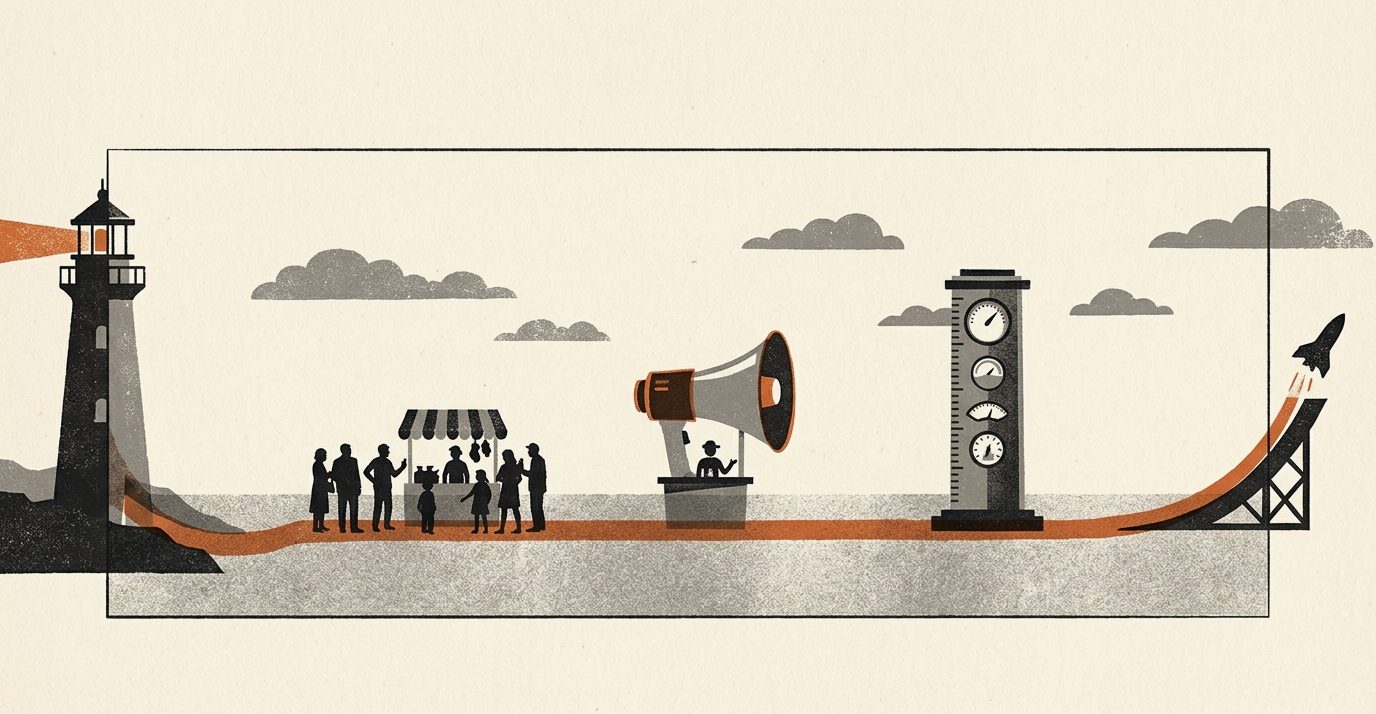
GAMMA. Five steps, each one leaves something behind.
G · Goals & Strategy
One North Star metric, tied to revenue, not to reach. A strategy the board can hold me accountable to.
Produces: the growth thesis, the metric, the quarterly targets.
Proof: a full marketing, sales and communication framework installed on a World Bank/IFC-XSML portfolio company, revenue up 58.4% from 2022 to 2024. Read the case
A · Audiences & Targeting
Micro-segmentation built on how people actually buy, not on how a Western persona deck says they should.
Produces: segments, priority markets, budget allocation.
Proof: at Bboxx, segmenting audiences on energy needs rather than geography cut cost per sale by 2.8 times, from $9.58 to $3.47, and cost per lead in Ghana from $0.48 to $0.24. Read the case
M · Messaging & Creative
Storytelling that converts. Creative built for the real conditions: low bandwidth, local languages, offline moments.
Produces: positioning, message house, creative system.
Proof: a performance engine of 12,000+ landing pages and 200K ads, tested continuously, for Canal+. Read the case
M · Measurement
Dashboards the founder actually opens. Weekly learning loops, not quarterly post-mortems.
Produces: real-time dashboards, a weekly decision cadence.
Proof: centralised real-time dashboards across 10 countries at Bboxx, with local execution autonomy. Read the case
A · Acceleration
Once it converts, scale it: automation, LTV, new channels, and a team trained to run it.
Produces: scale playbook, trained team, handover plan.
Proof: a fifteen-role marketing organisation across ten markets, functionally run, that kept running after handover. The growth marketing manager I recruited signed in 2024 the country decks I had signed in 2023. Read the case
Embedded, not remote-controlled.
I work inside your company, with the founder and the C-suite. In the market, in the salons, warehouses and field offices where the revenue actually happens. Fractional means a few days a month of senior firepower, not a retainer for slide decks.
The first 90 days
- Days 1-30
Terrain and data. I audit the funnel, sit with sales, visit the markets, and rebuild the numbers until they tell the truth.
- Days 31-60
The system. Positioning fixed, priority segments chosen, measurement installed, first quick wins shipped.
- Days 61-90
The cadence. Weekly dashboards running, team roles set, and the first repeatable growth loop live.
What you see every week
A dashboard, a decision list, and me in the room. No black box. You always know what is being spent, what it returns, and what changes next week.
The end is designed from day one
A mandate finishes with handover: your team trained to run the system without me. The test is not a document, it is a signature: on my last group mandate, the country decks I had signed one year were signed by the manager I had recruited the next. That is the standard.
How available are you on a fractional mandate?
Between two and eight days a month, embedded, depending on what the mandate is doing. Two to four when the system is built and the work is judgement and cadence. Six to eight in the phase where it gets built, because that phase needs hands, not advice. I take a small number of mandates at a time, so each one gets senior attention, on site when it matters. Between visits, the weekly cadence runs: dashboard, decisions, direct line.
Why fractional instead of a full-time CMO?
Because most companies at this stage need 20 years of experience a few days a month, not a full-time salary and a 6-month recruitment. You get the system, the senior judgement and the network now, and you hire full-time later, when the machine justifies it. I have helped boards do exactly that.
Do you work remotely or on the ground?
Both, but the terrain is non-negotiable. The mandates that work start on site: markets visited, sales teams observed, customers heard. Remote keeps the cadence between visits.
How long is a typical mandate?
Six months or more. The first 90 days build the system, the months after make it repeatable and train your team. Shorter than that, you buy a diagnosis, not a change.
What happens when you leave?
Handover is part of the mandate, not an option. Your team is trained to run the system, the dashboards stay, the playbook stays. If a consultant makes himself irreplaceable, he has failed.
Do you only work in Africa?
Africa is the core: East, Central and West African markets, plus the Indian Ocean. Work has also covered Europe and North America, mostly on e-commerce and performance.
Who it is for. Founders and leadership teams of companies with real traction: revenue, customers, a product that sells. What is missing is repeatability. Growth depends on heroics, the numbers do not add up between markets, and marketing cannot prove what it returns.
The problem it solves. In African markets the window to act is short. Competitors copy fast, funding cycles are unforgiving, and every quarter spent guessing is a quarter a system could have been compounding. The mandate replaces guessing with a machine: positioning, acquisition, measurement, team, commercial cadence.
The shape of it. A fractional CMO mandate, two to eight days a month depending on the phase, embedded with the founder and C-suite. Six months or more. On site regularly, on the dashboard weekly. It ends with handover: your team runs the system, I leave.
Why now. Because traction expires. The companies in the case studies moved when the traction was fresh. That is when a system multiplies it.
If this sounds like your company, let’s talk.
The first call30 minutes. We talk about your traction and what is blocking it. You leave with 2 or 3 moves you can act on. No pitch.