The premium brand measured all the way to the counter
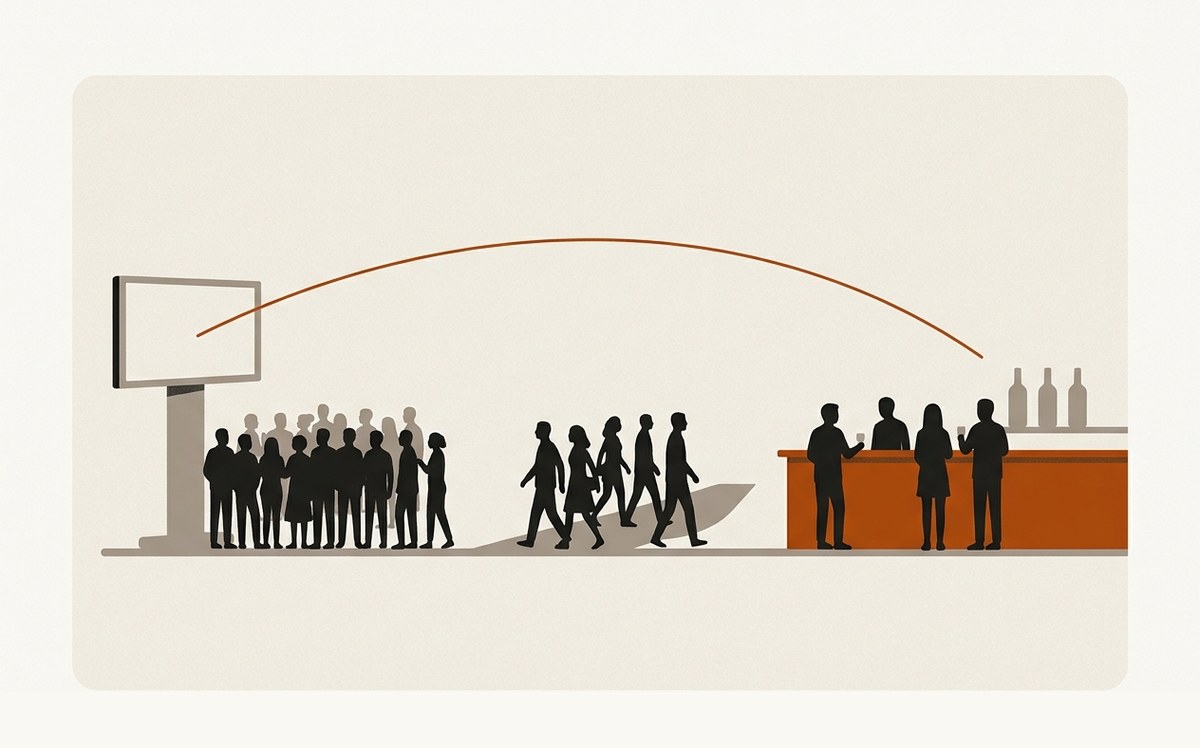
A premium spirits brand wanted a year-end operation that did something other than visibility. We built a system running from paid social to a physical tasting experience, then to purchase in store, and we measured every step.
The top of the system: 1.7 million impressions, reach of over 150,000 people, over 32,000 actions, and a click-through rate of 2.575% at a cost per action of 0.15 euro. The brand page gained 35% more followers over the six weeks of the operation.
The bottom of the system is what makes the page worth reading: over a thousand sign-ups to the experience, some of them captured in store on a tablet, then bookings, then attendance, then purchases. At every step, a percentage that drops and that can be explained.
The market is an island one, the category is premium, and the purchase is decided at the shelf, in front of six brands that look alike. Building awareness there is pointless: everyone already knows the brand. What is missing is a reason to pay more than the bottle next to it, and that reason is not installed by an advert, it is installed by an experience.
A system that runs to purchase crosses three territories that do not talk to each other: paid social, the physical event, and the point of sale. Each has its owner, its budget and its metric. Add that in a regulated category every message goes through approval, and that in-store sign-up means training hosts to capture data properly. Drop-off is not an accident, it is structural. The work is to measure it step by step rather than suffer it.
1 · Week one: listen and decide.
On site. Understand what the cooperative does, what its buyers and partners need to believe, and what the members are proud of. Positioning written and validated in the room, not by email.
2 · Week two: build the identity.
Visual identity designed against the positioning: name system, marks, colours, typography, and rules simple enough to be applied without a design team. Every choice tested against one question: does this raise institutional trust?
3 · Week three: ship the assets.
The working kit the cooperative actually needed: documents, signage, presentation materials, templates. Delivered with a short guide and a working session so the members could produce their own materials next month.
4 · Spend where perception changes.
The budget went into the few physical touchpoints partners actually see. Nothing was spent on deliverables that flatter the consultant.
2014 to 2016 operations, Indian Ocean.
- 1.7 million impressions and reach of over 150,000 people across six weeks
- Over 32,000 actions at a click-through rate of 2.575% and a cost per action of 0.15 euro
- Brand page up 35% in followers over the operation
- Over a thousand sign-ups to the experience, part of them captured in store on tablet
- System tracked through to purchase at the shelf, with the pass-through rate published at each step
- Over 70,000 people reached organically on a game mechanic, on a neighbouring brand in the portfolio
- Best cost per follower of the period at 0.07 euro
A premium brand is not judged on its reach, it is judged on its ability to make someone move. Once the system is measured to the counter, the conversation with the client changes: you no longer argue about view counts, you argue about the pass-through rate between two steps, and which one to fix first.
Does your brand campaign end anywhere?
The first call30 minutes. We talk about your traction and what is blocking it. You leave with 2 or 3 moves you can act on. No pitch.