The network went from nine outlets to four, and revenue rose 58 %
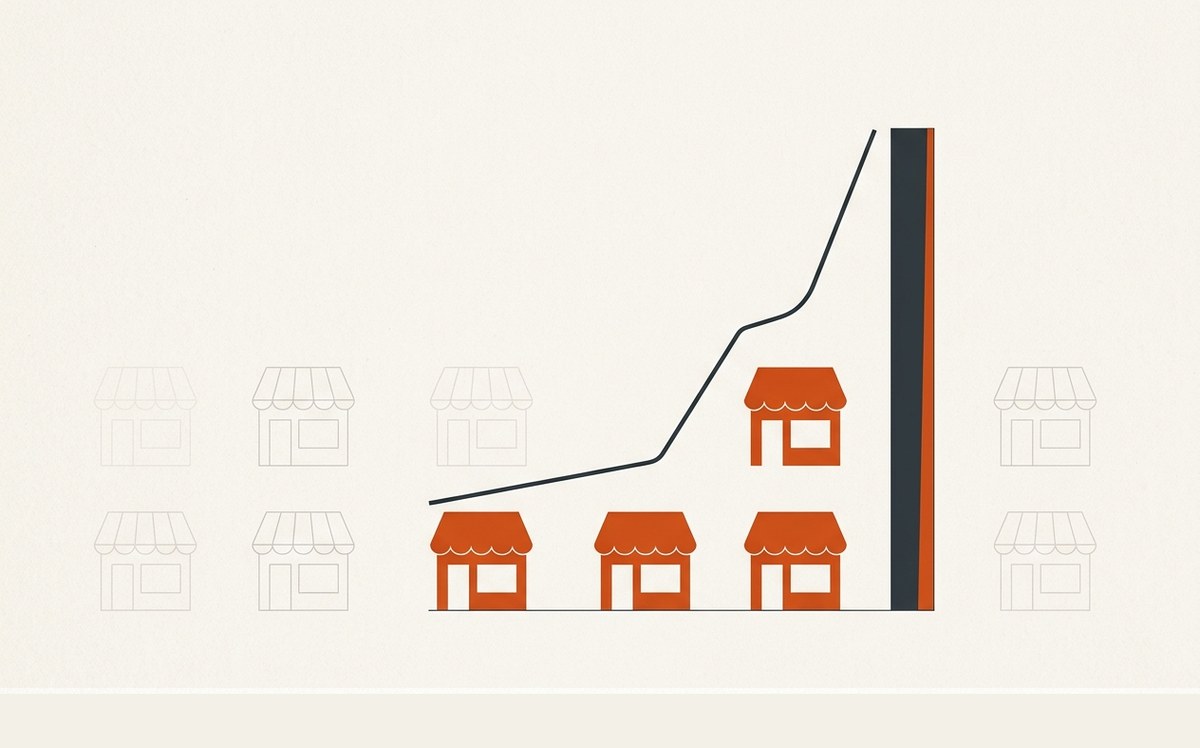
Between 2022 and 2024, a retail group I work with went from nine locations to four. Over the same window, its revenue grew 58.4 % and its gross margin moved from 62.8 % to 66.9 %.
Those three facts belong together, and the order they are told in decides how they land. Fewer outlets, more revenue, better margin. In that order it reads as consolidation. In the other order it reads as retreat.
What an over-extended network costs marketing
An outlet that misses its volumes does not just cost its rent. It consumes stock that is short elsewhere, management time, a share of the activation budget, and a place in the brand story. Every campaign has to mention it. Every promise has to hold there too.
Geographic coverage is easily confused with brand presence. They are not the same thing. A brand present in nine places where it is average is weaker than a brand established in four places where it is the reference.
What closing released, in proportions
First-half head office costs represented 55.7 % of revenue two years earlier, then 64.6 % the following year. After consolidation they fall to 22.9 %. And this point deserves the emphasis: on near flat revenue across the three half-years compared. Revenue did not explode, the structure simply stopped eating it.
First-half EBITDA moved from a negative figure to a positive one over the same comparison. Headcount came down by about a quarter and head office payroll by more than half.
Gross margin is the line marketing steers directly, through product mix, price and basket composition. It rises four points over the period.
The nuance that keeps the story honest
One market in the network declines over the period. The cause is not commercial: the local currency devalued and prices had not been readjusted. The correction was made in 2026.
I always give that point alongside the result, for a simple reason. A leader who hears a consolidation story with not a single shadow in it knows something is missing, and will go looking for the shadow instead of listening to the rest.
How to decide what to close
Not on the outlet's revenue. A store can carry volume and destroy value. The three questions I ask are elsewhere.
What is the outlet's contribution margin after allocating the structural cost it actually triggers, transport and supervision included. Many networks cannot answer, because head office costs are allocated pro rata to revenue, which mechanically protects the weak locations.
Is this outlet chosen by the customer, or endured. A location where people come because there is nothing else disappears the day something else opens.
And is what the closure releases actually reallocated, or merely saved. A consolidation that does not reinvest in the remaining outlets is not a strategy, it is a reduction in sail.
The marketing act
The part marketing teams underestimate is the exit itself. Closing an outlet without saying so damages the brand for longer than the closure does. The customers of that location have to be recovered towards another one, by name where the database allows it, with a reason to make the journey.
And the external message has to carry the concentration, not the excuse. A brand tightening onto its four best locations can say so. A brand explaining that it is closing for reasons beyond its control has already lost control of the story.
Going further: the method, and the case study a digital channel judged across three markets.
Is your network too wide for your brand? Request a Growth Audit