The client was cutting print because it proved nothing
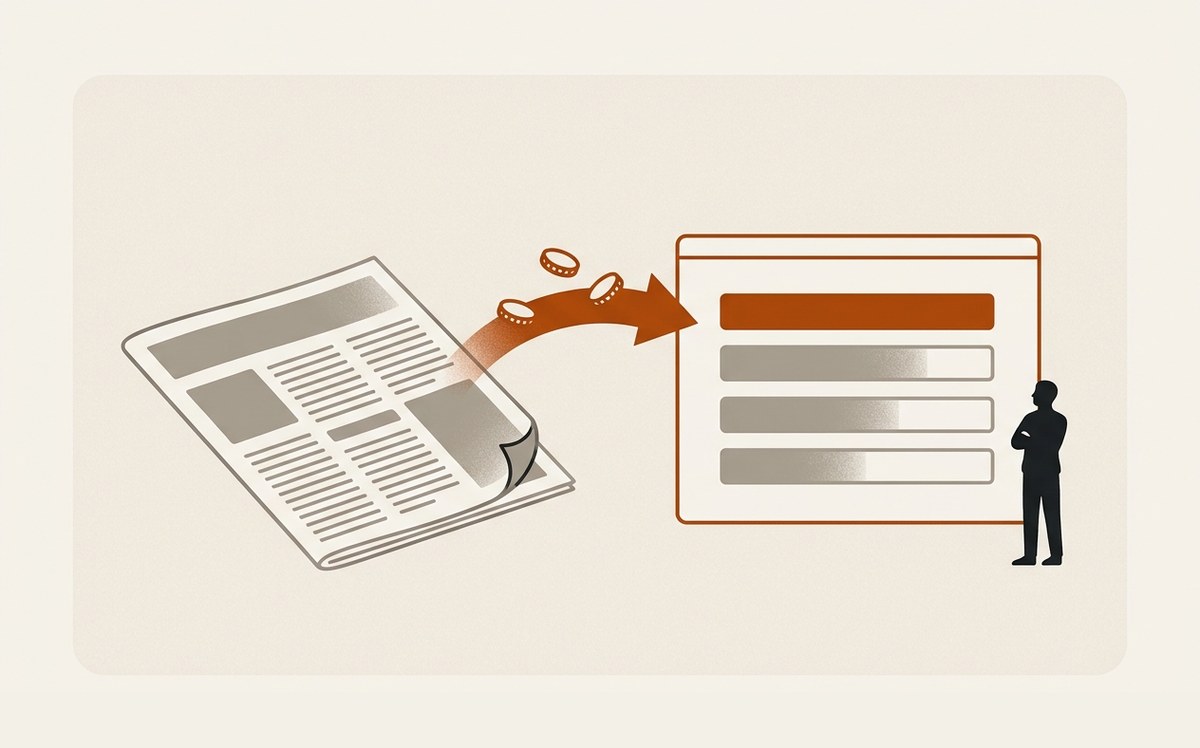
The client was not looking for a digital agency. He explained that he was cutting his print spend because it delivered very few results. That is the most useful sentence an advertiser can say, provided you know what to do with it.
We did not answer with a recommendation. We answered with a short paid search test campaign built around one question: does this budget produce something measurable, yes or no.
The best ad group came in at 6.73% click-through at an average cost per click of 0.61 euro, and a bounce rate of only 45%, meaning more than one visitor in two carried on. Three metrics, one message: this budget exists and it works.
A vehicle rental operator with two brands in the same island market, a near non-existent social presence, and most of its budget in local print. The sector is seasonal, the purchase decision happens in minutes on a search engine, and competition is regional. The digital starting point was close to zero on both brands, which is good news: everything measured afterwards is attributable.
Taking budget from an incumbent medium is not a matter of conviction, it is a matter of proof, and proof costs money you do not have yet. So you need a test budget small enough to be granted without heavy arbitration, and large enough to produce a readable result. Add seasonality, which makes any period-to-period comparison arguable, and the fact that a client already disappointed by one medium is wary of the next.
1 · Week one: listen and decide.
On site. Understand what the cooperative does, what its buyers and partners need to believe, and what the members are proud of. Positioning written and validated in the room, not by email.
2 · Week two: build the identity.
Visual identity designed against the positioning: name system, marks, colours, typography, and rules simple enough to be applied without a design team. Every choice tested against one question: does this raise institutional trust?
3 · Week three: ship the assets.
The working kit the cooperative actually needed: documents, signage, presentation materials, templates. Delivered with a short guide and a working session so the members could produce their own materials next month.
4 · Spend where perception changes.
The budget went into the few physical touchpoints partners actually see. Nothing was spent on deliverables that flatter the consultant.
2016 test campaign, pitch stage.
- 6.73% click-through on the best ad group
- Average cost per click of 0.61 euro across the test campaign
- Bounce rate of 45% on the strongest ad group, so more than one visitor in two carried on
- Best volume and quality pairing achieved on a specific offer, not on a brand query
- Full architecture set out at pitch: strategy, paid and organic search, social, video, events, distribution partnership
- Digital starting point close to zero on both brands, so the effect is fully attributable
An advertiser telling you their medium proves nothing is handing you the argument. The right answer is not to sell another medium, it is to sell the proof. A well chosen test campaign costs less than a thirty-page recommendation and settles the question in three weeks. If you cannot prove a pound is working, somebody will eventually give it back to print.
Can you prove a pound of media is working?
The first call30 minutes. We talk about your traction and what is blocking it. You leave with 2 or 3 moves you can act on. No pitch.