When growth stalls, spending more is almost always the wrong answer
Twice in two years I arrived on a file where the traffic curve was climbing and the revenue curve was falling. In both cases the room's first proposal was the same: put more money into media.
That proposal has one merit, it is immediate. It has one flaw, it treats the only stage of the funnel that was already working.
A channel that takes revenue in its first month, then stalls
On a mandate for a World Bank and IFC-XSML portfolio company, I launched a European e-commerce channel, paid acquisition and logistics included. It took revenue within its first thirty days, then a five-figure quarter.
The following quarter, revenue falls 57 % while visits rise 92 %. Twice as many visitors, almost half the sales.
When those two curves diverge that far, the problem is never acquisition. It is downstream, on conversion, or upstream, on awareness, which is to say on the reason an unknown visitor has to trust a brand they are discovering. More budget would have bought more visitors who did not convert.
I recommended pausing the media buy rather than renewing it, and I wrote down why. That is an uncomfortable recommendation to carry, because it amounts to asking for the shutdown of the budget line you were handed.
The mandate where the funnel lost everything before the page
The other file was a direct-to-consumer launch, over a short and properly instrumented window. The raw result: a three-figure media spend, one single sale, and a return on ad spend of nil against a target of two.
The number that explains everything sits elsewhere in the funnel: 99.25 % of the audience reached was lost before arriving at the landing page. Doubling the budget would have doubled the loss, to the euro.
The real cause was not in marketing. Price and distribution were not mine to steer, and not anyone's in that room. I took a rule from it that I have held since: I no longer take a marketing leadership mandate where price and distribution are out of reach. That is not a posture, it is a condition for delivering a result.
The question I ask before opening the media plan
It fits in one line: what is the one thing your customers would like you to fix, that has nothing to do with your communication.
The silence that follows is the diagnosis. A team that answers in three seconds knows its problem and has probably started on it. A team that cannot answer has been optimising channels for months to avoid opening a question about product, price, service or availability.
Where to look instead
Three gaps, in this order, and they can be read in half a day.
The gap between traffic and revenue. If they diverge, no acquisition spend recovers anything, and every additional pound makes the ratio worse.
The gap between billed clicks and sessions that actually landed. It is the most honest measure of waste available, and it is almost always worse than the ad platform's own dashboard suggests.
The gap between what the brand promises and what the company delivers. It cannot be read in a tool, it is read by calling customers. No amount of reach repairs a belief problem, it amplifies it and makes it public.
What this means for a leadership team
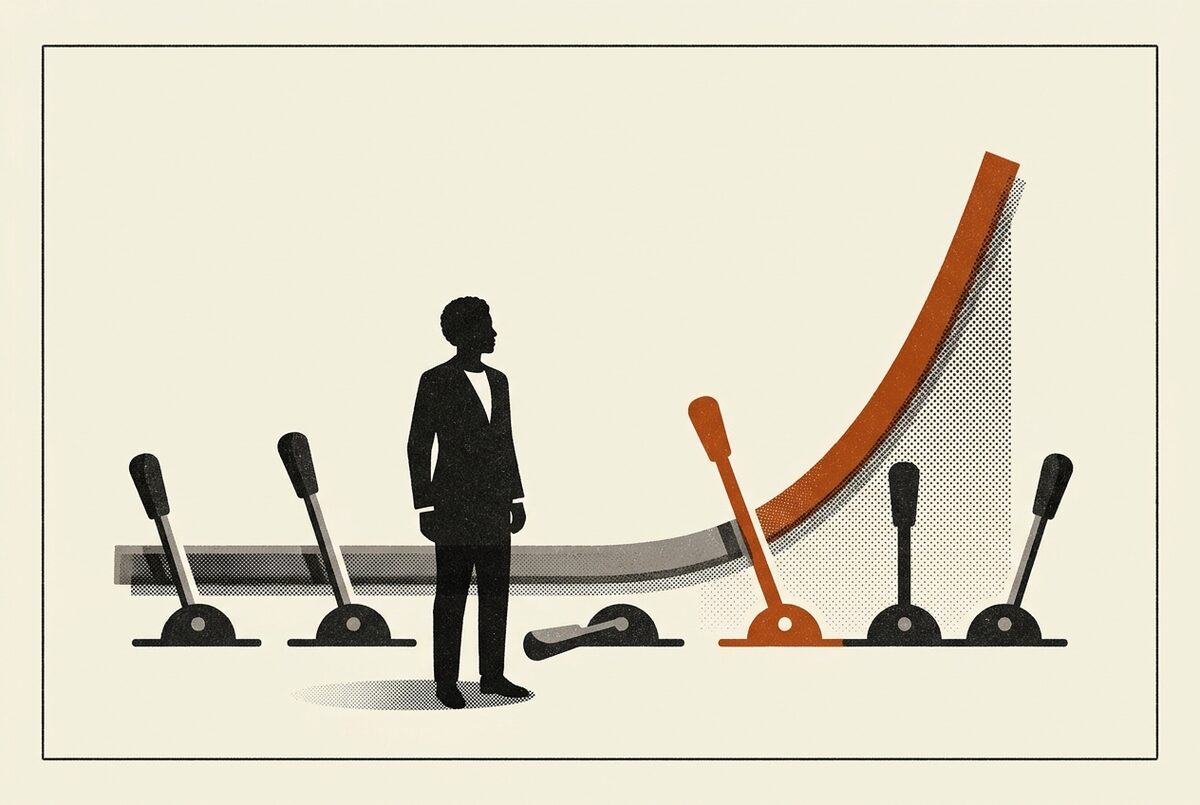
Growth that restarts almost never comes from a bigger budget. It comes from a lever being moved, and moving it costs courage rather than money: stopping a channel, changing a price, rebuilding a page, fixing a delivery, or telling a board that the campaign was not the problem.
If your reflex in front of a flat line is to spend more, that is exactly the moment to stop for a week.
Go further: explore the method and the case study the growth framework built from zero.
Stuck on flat growth? Find the real lever before you spend more. Request a Growth Audit