One institutional voice, built as a system, heard by the people who sign
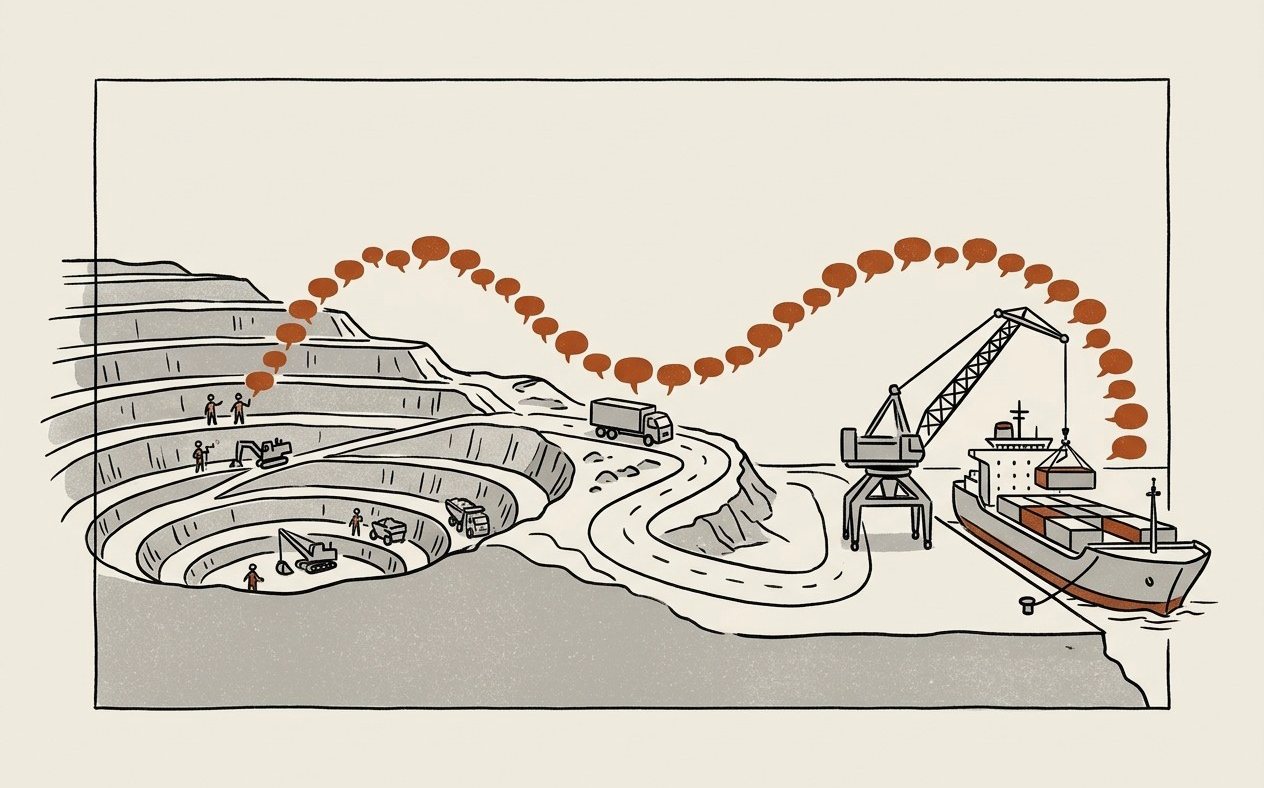
How does a B2B company build institutional credibility on LinkedIn, in a sector where one wrong word costs trust? With a content system, not with posts. This mandate, part of my fractional portfolio since 2024, is with a B2B technology company building digital market infrastructure for regulated extractives: mineral traceability, at pan-African scale. Its buyers and partners are governments, institutions and corporate leadership. They do not respond to growth hacks.
The work: build the company's institutional voice on LinkedIn as a system. A defined position, held with discipline. Data-backed content, where every claim traces to a source. Distribution designed for the C-suite audience that actually decides, not for volume. A production cadence the company can sustain, with measurable reach growth reviewed against the pipeline conversations it opens.
This is an active mandate, and the client's business figures stay theirs. What is said publicly is the shape of the system and its own indicators: eight weighted axes, forty posts measured at day 1 and day 3, a baseline reach of 200 to 350 views taken past the thousand on the best posts. The transferable lesson: in institutional B2B, credibility compounds like interest, and only systems compound.
Regulated extractives run on trust. A technology company in mineral traceability sells, in the end, one thing: confidence that the system is exactly what it claims to be. The company had substance, data, operations on the ground. What it lacked was a public voice at the level of its institutional counterparts. In this sector, silence gets filled by others, and by suspicion.
Every word is exposed. The audience includes regulators, institutional partners and sector specialists who read critically and remember. Overclaim once and the credibility account is emptied. The positioning vocabulary is strict: the company is market infrastructure, and it must never be described in terms that would place it elsewhere in the value chain. Add the usual B2B reality: a small team, no content factory, and an audience too senior to be reached by advertising.
1 · A position, written down and held.
One definition of what the company is, one vocabulary, enforced across every post and every speaker. Consistency is the strategy.
2 · Data-backed content.
Each piece of content is built on the company's own operational data or on verifiable sector sources. Claims trace to numbers; numbers trace to sources. The content earns the right to be repeated by others.
3 · C-suite distribution.
Content designed and sequenced for the specific institutional and executive audience that signs, using the company's leadership as the voice. Reach is measured where it matters, in that audience.
4 · A cadence the company can hold.
An editorial system with defined formats and a sustainable rhythm, so the voice survives busy quarters. A voice that stops is worse than a voice that never started.
5 · Measurement, reviewed continuously.
Reach growth tracked and reviewed against the conversations it opens. Institutional content is judged by who engages, not how many.
Content-system indicators; the client's business metrics stay theirs.
- Eight weighted content axes, actual coverage held within 5 points of target weights
- 40 posts published, each measured at day 1 and day 3
- Baseline reach of 200 to 350 day-one views, up to 886, 1,018 and 1,029 day-one views on the best post of three separate axes
- Around 286 new followers attributed over the measurement window
The same systems discipline that runs acquisition funnels runs institutional credibility. Positioning held, claims sourced, cadence kept, results measured. If your company's public voice is quieter than its substance, that gap is closable, and it closes with a system.
A voice to build, a sector that forgives nothing?
The first call30 minutes. We talk about your traction and what is blocking it. You leave with 2 or 3 moves you can act on. No pitch.