Your competitors are your best distribution channel
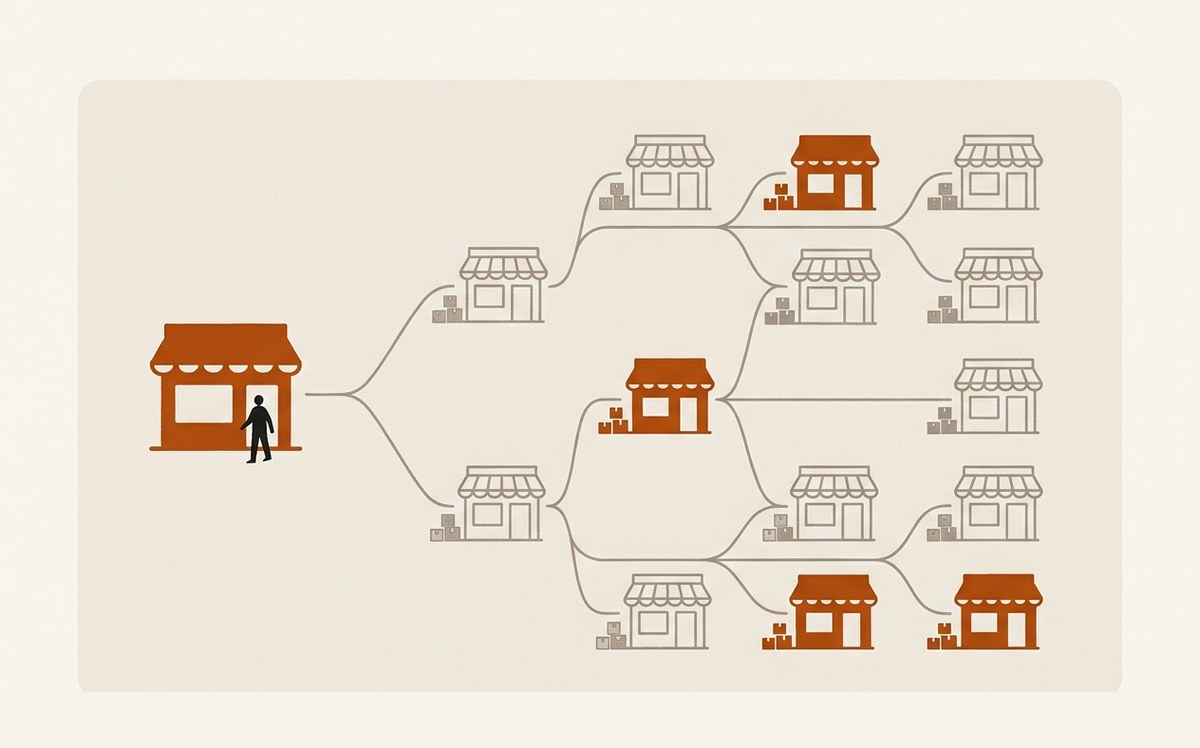
A premium retail group sold direct, in its own outlets, to customers who came to it. The model worked, and it had a ceiling: the number of chairs, the number of hours, the number of cities. Growing meant opening one more address, which means tying up capital for every increment of revenue.
The way past that ceiling was in plain sight and nobody was looking at it. The independent salons in town, the ones treated as competitors, were already using the same product. They bought it elsewhere, paid more for it, with no guarantee of origin or quality. They were not competitors to fight, they were a distribution network that did not know it was one.
In one quarter, the base of professional salons integrated into the system grew by more than 250 percent. This page is about how you reclassify a competitor as a customer, and what it costs to do it properly.
The group ran its own outlets in three countries, with a strong consumer brand and an imported product of consistent quality. Facing it, a dense fabric of small independent salons delivering the same service on irregular supply. The group treated them as competition. They were, on the end customer. They were not at all on the product, where the group had a purchasing and supply chain advantage none of them could match.
Selling to your competitor means answering the question they will ask: why would you help me? So you need an offer that works for them, a price that does not cannibalise retail, and a minimum order quantity that protects logistics without excluding the small ones. Add three countries, different currencies, a professional clientele buying cash and short-term, and a low average monthly basket per salon at the outset, which the advisory document itself calls low. The channel only becomes profitable through numbers, so through recruitment, so through commercial work that marketing alone does not do.
1 · Week one: listen and decide.
On site. Understand what the cooperative does, what its buyers and partners need to believe, and what the members are proud of. Positioning written and validated in the room, not by email.
2 · Week two: build the identity.
Visual identity designed against the positioning: name system, marks, colours, typography, and rules simple enough to be applied without a design team. Every choice tested against one question: does this raise institutional trust?
3 · Week three: ship the assets.
The working kit the cooperative actually needed: documents, signage, presentation materials, templates. Delivered with a short guide and a working session so the members could produce their own materials next month.
4 · Spend where perception changes.
The budget went into the few physical touchpoints partners actually see. Nothing was spent on deliverables that flatter the consultant.
2024 mandate, three countries and an e-commerce channel.
- Base of professional salons integrated into the system up more than 250 percent in one quarter
- B2B channel segmented into three distinct trades, each with its own price grid, minimum quantity and payment cycle
- Consignment process then switch to firm purchase above a sell-through threshold, so partners start with no cash risk
- Owned reselling platform launched, over eleven thousand unique visitors in thirty days and revenue within the first two weeks
- Negotiations opened with regional supermarket chains, an international multi-country retailer, a pan-African marketplace and a European distribution network
- B2B event kit produced: stand, argument and executive speaking preparation
A retail brand's ceiling is almost never demand, it is the number of its own addresses. The fastest way past it is to look at who, in the same market, is already selling your product without you. A competitor who buys from you is no longer a competitor, it is a point of sale you did not pay for. You just have to give them a grid, a minimum quantity and a reason to stay.
Is your ceiling demand, or the number of your addresses?
The first call30 minutes. We talk about your traction and what is blocking it. You leave with 2 or 3 moves you can act on. No pitch.